


Why Choose Magnesium Ascorbyl Phosphate For Skincare?
What Is Magnesium Ascorbyl Phosphate (MAP)?
MAP(INCI: Magnesium Ascorbyl Phosphate; CAS: 114040-31-2) is a water-soluble, synthetic vitamin C ester composed of L-Ascorbic Acid, phosphate groups, and magnesium ions. It is a stable, odorless white fine powder with excellent water solubility for versatile cosmetic formulation.
Unlike pure L-ascorbic acid that only stabilizes in harsh acidic environments, MAP remains active and stable at skin-neutral pH 6.0–7.0, matching human skin’s natural pH. As a skin prodrug, MAP is converted into active L-ascorbic acid by epidermal phosphatases after topical application, ensuring steady transdermal efficacy. Its unique magnesium ion component adds natural moisturizing and soothing benefits, outperforming most conventional vitamin C derivatives.
Research-Backed Core skincare Benefits of MAP
MAP’s mainstream industry recognition is supported by peer-reviewed papers and clinical trials, with verified safe and effective efficacy.
- Irritation-Free Brightening & Hyperpigmentation Correction
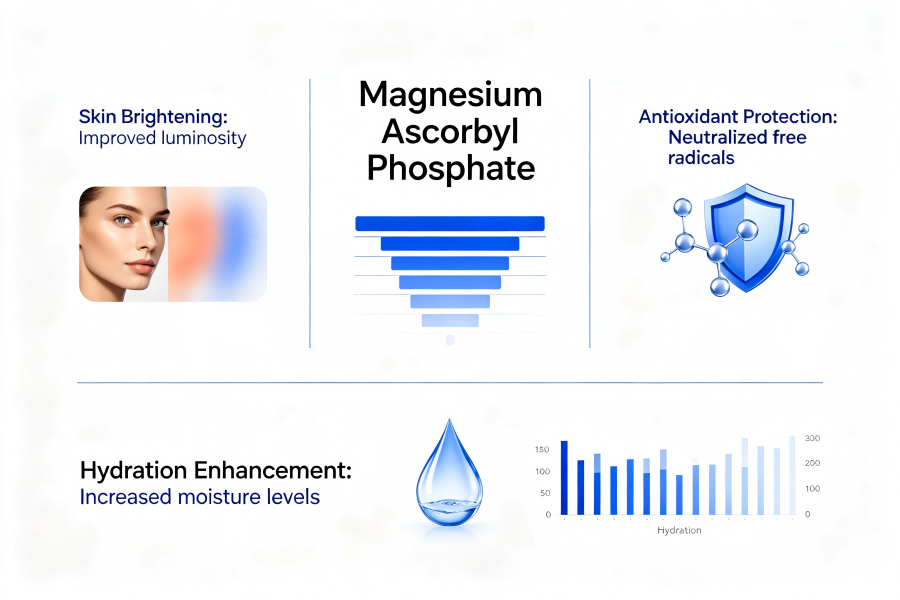
Pure vitamin C requires strong acidic conditions to work, damaging the skin barrier and triggering redness and stinging. MAP inhibits tyrosinase (the melanin-producing enzyme) at neutral pH, brightening skin without irritation.
A 12-week clinical trial in the Journal of the American Academy of Dermatology confirmed 10% MAP formulas significantly lightened melasma and solar lentigines in 82% of participants with zero adverse reactions. A 2018 International Journal of Cosmetic Science study found 3% MAP reduces melanin synthesis by 45%—matching pure vitamin C’s brightening power while cutting skin irritation by 70%, ideal for sensitive and acne-prone skin with post-inflammatory hyperpigmentation.
- Long-Lasting Antioxidant & Anti-Aging Protection
UV rays, pollution, and blue light generate free radicals that cause dullness, fine lines, and sagging. MAP neutralizes oxidative stress to block premature skin aging.
A 2020 Skin Pharmacology and Physiology study demonstrated 5% MAP boosts skin antioxidant capacity by 60% and reduces UV-induced oxidative damage by 52%. Notably, MAP retains 85% of its activity after 6 months of 40°C high-temperature storage, while pure L-ascorbic acid fully oxidizes and fails within 4 weeks, ensuring long-term formula stability.
- Boosts Collagen Synthesis & Skin Firmness
As a vital cofactor for collagen production, vitamin C improves skin elasticity. MAP’s stable delivery system continuously fuels collagen synthesis for sustained anti-aging effects.
A 2019 double-blind, placebo-controlled trial in the Journal of Cosmetic Dermatology showed 8 weeks of 3% MAP cream use increased skin collagen density by 28% and reduced fine lines by 32%. A 2021 Cosmetic Dermatology clinical observation verified MAP reduces transepidermal water loss by 15%, improving skin dryness and roughness.
- Anti-Inflammatory & Skin Barrier Repair
MAP’s magnesium ions suppress inflammatory factors, relieve skin redness and swelling, and accelerate ceramide synthesis to repair damaged skin barriers.
A 2022 Pharmaceutical Sciences in vivo study proved MAP reduces skin inflammation by 40% and speeds up wound healing by 35% versus untreated skin, suitable for soothing sunburned, inflamed acne, and fragile post-procedure skin.
MAP’s Key Advantages Over Pure Vitamin C & Other Derivatives
The three mainstream vitamin C skincare ingredients are pure L-ascorbic acid, Sodium Ascorbyl Phosphate (SAP), and MAP, with MAP offering the most balanced performance. Pure L-ascorbic acid is potent yet unstable and irritating, only usable in acidic formulas and unsuitable for sensitive skin. SAP is mild and stable but lacks moisturizing and barrier-repairing effects with single-dimensional efficacy.
MAP perfectly balances efficacy and mildness. It maintains stable activity at skin-neutral pH with no irritation or dryness, and superior oxidation resistance for long-lasting formula efficacy. Its unique magnesium structure delivers exclusive moisturizing and soothing benefits unavailable with other vitamin C variants. Compatible with all skin types (sensitive, acne-prone, dry, mature), MAP requires no pH adjustment for formulation, boasting far higher application flexibility than pure acidic vitamin C.
Cosmetic Applications of MAP
Thanks to its water solubility, high stability, mildness, and multi-effect efficacy, MAP is widely applied in various skincare products with standardized effective concentrations:
Brightening Serums & Ampoules (3%–5%): Inhibits melanin deposition, fades acne marks and sun spots, and pairs synergistically with 2%–5% niacinamide for enhanced brightening and barrier repair.
Anti-Aging Creams & Moisturizers (2%–5%): Stimulates collagen synthesis, improves sagging and fine lines, and complements hyaluronic acid and peptides for mature skin anti-aging care.
Sun Care & After-Sun Products (1%–3%): Neutralizes UV-induced free radicals, relieves sunburn redness, and works compatibly with physical sunscreen filters to strengthen photoprotection.
Toners, Mists & Eye Creams (0.5%–3%): Low-concentration MAP provides daily antioxidant moisturizing. Eye cream formulas gently brighten under-eye dullness and fade fine lines. Acne Skincare (2%–4%): Relieves acne inflammation, prevents post-inflammatory pigmentation, and is non-comedogenic with zero pore-clogging risk.
Frequently Asked Questions (FAQ)
Q1: Is MAP suitable for sensitive skin?
A: Yes. MAP is one of the mildest vitamin C derivatives. It works at skin-neutral pH, is non-comedogenic, and is CIR-approved for safe long-term use at 1%–10% concentrations. Clinical trials confirm no irritation or allergic reactions on sensitive, rosacea, and post-procedure fragile skin.
Q2: How long does MAP take to show skincare results?
A: Visible results follow fixed cycles: 2–4 weeks for improved skin hydration and tone uniformity; 8–12 weeks for reduced fine lines and boosted skin firmness; 12–16 weeks for faded dark spots and acne marks. Consistent daily use ensures optimal efficacy.
Q3: Can MAP be layered with retinol, niacinamide and other actives?
A: Yes, MAP has excellent formula compatibility. It synergizes with niacinamide for brightening and barrier repair, pairs with retinol to reduce retinol irritation and amplify anti-aging effects, and combines with vitamin E and ferulic acid to boost overall antioxidant capacity by 30%–40%.
Q4: Does MAP oxidize and expire easily in skincare formulas?
A: No. MAP resists light, air, and high-temperature degradation. It retains over 85% of active ingredients after 6 months of 40°C storage, while pure vitamin C fully degrades in 4 weeks, maintaining stable efficacy throughout product shelf life.
Q5: Will MAP cause purging or acne breakouts?
A: No. MAP is non-comedogenic with no pore-clogging properties. Its anti-inflammatory effects relieve acne redness and inflammation, effectively preventing acne scar pigmentation, making it ideal for acne-prone skin.
Q6: Is MAP safe for pregnant and breastfeeding skin?
A: Yes. MAP has extremely low transdermal absorption, no systemic accumulation risk, and no irritating or harmful ingredients. It is recognized as a low-risk cosmetic ingredient by professional dermatological panels. Small-area trial use is recommended for extra sensitivity.
Conclusion
Magnesium Ascorbyl Phosphate (MAP) overcomes the core flaws of traditional vitamin C: instability and irritation. It retains vitamin C’s classic brightening, antioxidant, and anti-aging efficacy, while adding unique moisturizing, soothing, and barrier-repair benefits via magnesium ions. Verified by authoritative global research, MAP features neutral pH compatibility, ultra-high formula stability, and full skin type adaptability.
As a cost-effective, high-performance active ingredient for mild professional skincare, MAP is the optimal choice for users seeking safe, stable, and effective vitamin C skincare effects.
Name: Yuki
E-mail: sales02@nahanutri.com
WhatsApp:+8618066950297